






Why Use the Bi-Air® Filter Cassette?
- The Bi-Air® cassette has been designed specifically for the collection and quantitative analysis of both total fungal spores and culturable (viable) fungi on the same sample.
- The collection of fungal spores is highly efficient, resulting in significantly higher concentrations compared to adhesive strip samplers; and, collection efficiency is independent of spore size.
- The area of the Bi-Air® sample trace is only 1/3 the area of the typical sample trace produced by adhesive strip samplers, resulting in both lower sample volumes and easier sample analysis by the microscopist.
- The Bi-Air® Cassette has been designed to collect airborne samples.
- The Bi-Air® Cassette has been designed to collect wall cavity samples.

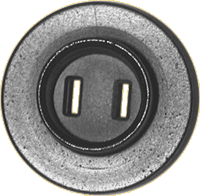
Dual-slit filter makes the Bi-Air® unique
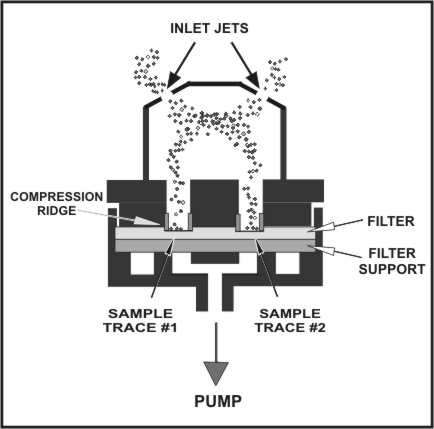
The Bi-Air® cassette has been designed specifically for the collection and quantitative analysis of both total fungal spores and culturable (viable) fungi on the same sample.
The Bi-Air® cassette produces two distinct sample traces on one filter during sample collection. Since the fungal spores are collected on two distinct areas of the filter media during sample collection, the filter is easily cut in half, allowing each sample trace to be analyzed by different methods. For example, total fungal spores can be counted microscopically using one sample trace, while the second sample trace is cultured for viable fungi using dilution plating techniques. Adhesive strip samplers are generally limited to the collection and analysis of total airborne fungal spores.
The two sample traces are identical in area and are easily separated. This allows a quantitative analysis to be performed on each separate sample trace. In addition, validation sampling has shown that the median concentrations of fungal spores collected in each trace during the collection of a single sample are not statistically different.
A siginificant advantage is that the culture media (any numbers of culture media) can be cultured after the sample has been collected and after spore identification.
The collection of fungal spores is highly efficient, resulting in up to 3-times higher concentrations compared to adhesive strip samplers; and, collection efficiency is independent of spore size.
Samplers based on the collection of fungal spores on adhesive strips require an air gap between the inlet of the sampler and the collection media. This gap allows some spores, especially the smaller spores such as Aspergillus/Penicillium, to bypass the collection media. The Bi-Air® cassette uses a filter as the collection media, so the sampler inlet is placed directly on the surface of the filter. This design prevents the spores from bypassing the collection media.
The air gap in adhesive strip samplers also allows the sample trace to spread out, making it difficult for the laboratory analyst to find new sample. The Bi-Air® cassette not only places the inlet directly onto the surface of the filter, but a gasket, in the form of a small wedge on the bottom of each slot, acts to seal the edges of the sample trace, confining the spores to a well-defined area on the filter. The wedge also indents the filter media, allowing the microscopist to easily find the sample traces.
The area of the Bi-Air® sample trace is only 1/3 the area of the typical sample trace produced by many adhesive strip samplers.
Typical adhesive strip samplers have an inlet that is about 1 mm x 14.5 mm. Due to the air gap between the inlet and the collection media, these samplers produce a sample trace with a nominal size of about 2 mm x 14.5 mm, resulting in a sample trace with an area of about 29 mm2. At a magnification of 600X, which is typically used by many commercial microbiology laboratories for the analysis of total fungal spores, this area is equivalent to about 364 microscopic fields of view.
In comparison, the Bi-Air® cassette produces a sample trace with an area of 9.35 mm2. This is equivalent to about 120 microscopic fields of view at a magnification of 600X. The Bi-Air® cassette was specifically designed to make it easier for the microscopist to analyze the entire sample.
In addition, the collection efficiency of the Bi-Air® cassette may be as much as 10-times greater than the collection efficiency of the Air-O-Cell™ cassette.
The Bi-Air® Cassette has been designed to collect airborne samples.
The collection efficiency of the Bi-Air® cassette has been optimized for the collection of both small (Aspergillus/Penicillium) spores and the larger spores (Ulocaldium, Alternaria). The 6-hole circular inlet provides two advantages. First, it increases the capture velocity so that the larger fungal spores are collected efficiently. Second, when oriented vertically, it is omni-directional and less affected by wind direction compared to a rectangular inlet.
Since the sample trace is only a third of the area of an Air-O-Cell™ cassette, a 25 liter sample collected using a Bi-Air® cassette would be equivalent to a 75 liter sample collected using an Air-O-Cell™ cassette.
However, the higher pressure drop associated with the small sample area limits the airflow rates that can be used with the Bi-Air® cassette. The maximum airflow rate is about 4 lpm when using a 1.2 um MCE filter. The collection efficiency has been optimized for an airflow rate of about 3.5 lpm. Therefore, a 7-minute sample collected at 3.5 lpm using a Bi-Air® cassette would be equivalent to a 5-minute sample collected at 15 lpm using an Air-O-Cell™ cassette.
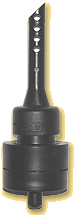
Bi-Air® with probe attached
for wall cavity sampling
The Bi-Air® Cassette has been designed to collect wall cavity samples.
Wall cavity samples are also easily obtained using the Bi-Air® cassette and the perforated sample probe. The sample probe is perforated, beveled, and has a large internal diameter, practically eliminating the problems of crimped or clogged sample probes. In addition, the sample probe is made of a conductive plastic that is designed to dissipate surface charges, minimizing any sample loss in the probe. A similar sample probe is available for the Air-O-Cell™ cassette. It has a rectangular base that fits directly onto the inlet of the Air-O-Cell™ cassette.
The Bi-Air® cassette provides information on both total spore and culturable fungus. The ratio of total spore to culturable fungus provide some some indication of the relative age of the incident.
As with ambient air samples, both total fungal spores and culturable fungi can be collected in the same sample. An airflow rate of 1 lpm and a sample time of two minutes is sufficient to detect the presence of fungal contaminants in hidden spaces. Therefore, a low-volume personal sampling pump is all that is necessary for sampling wall and ceiling cavities.
COMPARISON OF THE BI-AIR® CASSETTE AND THE WALLCHEK® FOR COLLECTING WALL CAVITY SAMPLES
| Characteristic | Bi-Air® | WallChek® |
| Collects total airborne fungal spores | Yes | Yes |
| Collects culturable (viable) fungi | Yes | No |
| High collection efficiency | Yes | No |
| Collection efficiency varies with spore size | No | Yes |
| Change sample probe for each sample | Yes | No |
| Quiescent sampling possible | Yes | Yes |
| Aggressive sampling possible | Yes | No |
| % of air removed from full-height stud bay | 3% | 23% |
| % of air removed from stud bay under window | 8% | 56% |
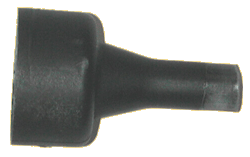
Wall cavity probe, cut for calibration
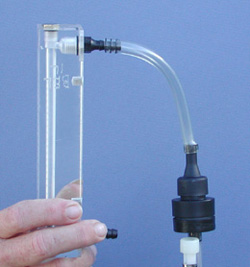
Calibration using a rotometer and cut probe
The Bi-Air® cassette is easily calibrated using the sample probe.
The sample probe has a round base to fit the Bi-Air® cassette. The ends of the probes are perforated to minimize clogging when they are inserted into a wall cavity. If the perforated tip of a sample probe is cut off (for example, with a utility knife), the solid portion of the probe may be used to calibrate the respective cassette.